Alone in the Studio: Why Going Solo Might Be Your Most Radical Creative Choice
Somewhere along the way, collaboration became synonymous with ambition. If you're working alone, the implication is that you haven't found your people yet, or worse, that nobody wants to work with you. The creative world — especially online — treats partnership like a badge of legitimacy. Duo projects, writer's rooms, collab drops, co-authored everything. It's practically built into the culture now.
And look, collaboration can be genuinely great. Some of the most powerful creative work in history came from two or more people pushing each other into territory neither would have found alone. That's real. That matters.
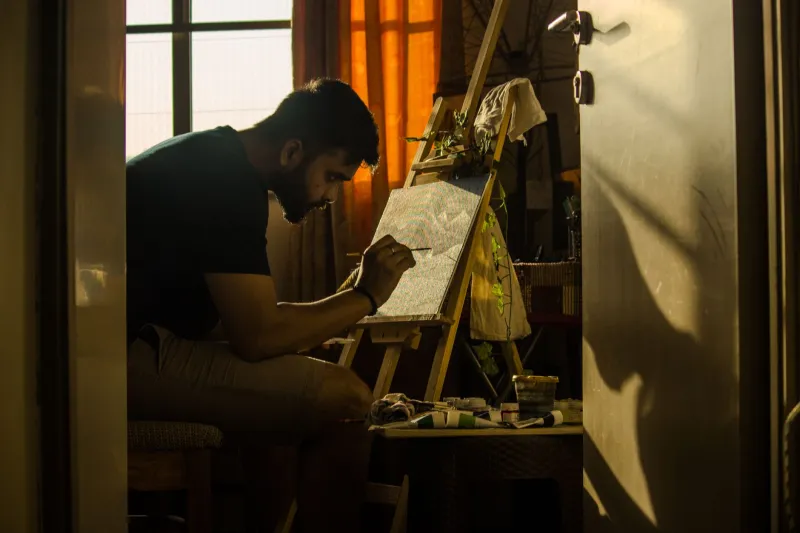
But there's a side of this conversation we tend to skip over: sometimes the best thing you can do for your work is close the door, turn off the group chat, and just be in it by yourself.
The Noise Nobody Talks About
When you bring another person into your creative process, you're not just adding their skills — you're adding their instincts, their preferences, their blind spots, and their relationship to risk. That's not inherently bad. But it does mean you're no longer working in a straight line from your gut to the page, the canvas, the screen, or wherever your work lives.
There's a negotiation that happens, even in the best collaborations. Subtle stuff. You pitch an idea and read the room. You feel the slight hesitation from your collaborator and you sand the edges off something that maybe didn't need sanding. You make a hundred small adjustments to keep the partnership running smoothly, and by the end, the work is a compromise — a beautiful one, maybe, but a compromise nonetheless.
When you're alone, that negotiation disappears. What's left is just you and the weird, uncomfortable, sometimes embarrassing truth of what you actually want to make.
Solitude Is Where the Weird Stuff Lives
Here's something I've noticed: the most distinctive parts of any creator's output tend to come from their solo work. The albums musicians make by themselves in their home studios. The comics artists write and draw without an editor breathing down their neck until the thing is basically done. The novels that took a decade and no writing group.
There's a reason for that. When you're accountable only to yourself, you're free to follow the thread that makes no obvious sense. You can spend three weeks on a detail that might not even survive the final cut. You can change direction entirely on a Tuesday because something felt off and you can't explain why. That kind of creative freedom is genuinely hard to protect inside a collaboration, no matter how good the partnership is.
The weird stuff — the specific, idiosyncratic choices that make your work yours — tends to get smoothed out in group settings. Not maliciously. Just naturally. Consensus is the enemy of specificity, and collaboration, almost by definition, moves toward consensus.
When Collaboration Actually Works
None of this is an argument against ever working with other people. That would be ridiculous. The point is more about being honest with yourself about what a given project actually needs.
The collaborations that genuinely amplify rather than dilute creative vision tend to share a few things in common. First, there's a clear lead — someone whose vision is the north star, and whose collaborator is there to help realize that vision rather than co-author it from scratch. Think of a filmmaker working with a cinematographer they deeply trust. The director isn't splitting creative ownership; they're finding a skilled partner to help them see their own ideas more clearly.
Second, the best creative partnerships tend to happen between people whose strengths are genuinely different. Not just complementary on paper, but different in ways that create productive friction rather than comfortable agreement. If you and your collaborator always think alike, you're probably not pushing each other anywhere new.
And third — this one's underrated — the best collabs usually happen when both people already have a strong solo practice. When you know what your work looks like when you're the only one in the room, you're a much better collaborator. You have something specific to bring. You know where your edges are. You're not looking to the other person to define the work for you.
The Pressure to Partner Up
Social media has done something interesting and kind of annoying to creative culture. It's made process visible in ways that weren't possible before, which is mostly great — but it's also created this ambient pressure to be seen collaborating. The collab post performs well. The duo announcement gets engagement. The "we're working on something together" tease builds anticipation.
And so there's an incentive, even a subconscious one, to seek out partners not because the work demands it but because the optics of collaboration feel more exciting than the image of someone just... sitting alone, making something.
That's worth examining. If you're pulling someone else into your process primarily because it feels more legitimate or more shareable, that's not a creative decision — it's a marketing decision dressed up as one. And your work will probably show it.
What Solo Work Actually Requires
Working alone is harder in a specific way that people don't always acknowledge. Without external accountability, you have to build your own. Without a collaborator to tell you something isn't working, you have to develop the internal sensitivity to hear that yourself. Without the energy of another person in the room, you have to generate your own momentum on the slow days.
That's a real skill set, and it takes time to build. A lot of creators abandon solo projects not because the work wasn't good but because they didn't have the infrastructure — internal or external — to sustain the process on their own.
But here's the thing: building that capacity is worth it. The ability to sit with your own work, in the silence, and keep going — that's not just a practical skill. It's how you find out what you actually believe about the thing you're making. It's how the work gets to be genuinely, specifically, uncomfortably yours.
Closing the Door
If you've been feeling like your work has gotten a little blurry lately, a little hard to describe as distinctly you, it might be worth asking whether you've been collaborating more than your instincts actually want.
Not every project needs a partner. Not every idea is better with input. Sometimes the most interesting thing you can do — for your audience, for your creative development, for the work itself — is just close the door and see what happens when it's only you in the room.
The result might surprise you. It might embarrass you a little. It might be stranger and more specific and less polished than anything you'd have made with someone else.
That's probably a sign you're onto something.