Going Back In: Why Revisiting Old Work Is One of the Bravest Things You Can Make
The Stuff You Boxed Up Isn't Done With You
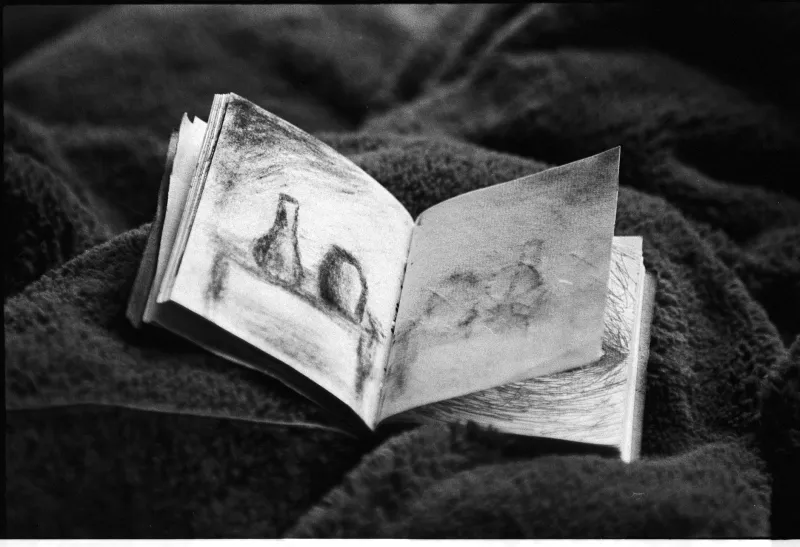
Somewhere in your hard drive, your closet, or the back corner of a sketchbook you haven't touched in three years, there's a piece of work you left behind. Maybe you thought it was finished. Maybe you knew it wasn't. Maybe you just got tired of looking at it and moved on to the next thing, the way you do.
Here's what I've noticed though: that old stuff has a way of pulling at you. Not because it's broken and needs fixing. But because you've changed, and now you're looking at it with different eyes — eyes that have seen more, failed more, learned more. And suddenly that old piece isn't just an artifact. It's an invitation.
Revisiting old work isn't nostalgia. It's not admitting defeat. Done right, it might be one of the most honest creative acts you can pull off.
The Difference Between a Revision and a Reimagining
This matters, so let's be clear about it upfront.
Revising is when you go back to clean something up — tighten the prose, fix the composition, correct the thing that was always slightly off. That's craft maintenance. Totally valid. But that's not what we're talking about here.
Reimagining is something else entirely. It's when you take the raw material of what you made and run it through who you are now. You're not correcting past-you. You're in dialogue with past-you. The original piece becomes source material — a seed, a prompt, a jumping-off point — and what comes out the other end is genuinely new work that couldn't exist without both versions of you contributing to it.
Think about how many musicians have re-recorded old albums years later. Or how painters have returned to the same subject across decades of their career. Or how novelists have revisited characters they thought they were done with. The best versions of those returns aren't apologies for the originals. They're expansions. They're what happens when the same question gets asked by someone who's lived more of the answer.
What the Gap Between Then and Now Actually Reveals
There's something almost archaeological about going back into old work. You start to see the layers — not just in the piece itself, but in yourself.
When I look at things I made five, eight, ten years ago, I can read them like a diary I didn't know I was keeping. The obsessions I was circling without realizing it. The fears I was working around instead of through. The aesthetic choices I made because I was trying to sound like someone else, or because I was terrified of going further in the direction I actually wanted to go.
That's the confession part. Old work tells the truth about who you were in ways you couldn't have articulated at the time. You were too close to it. Now you have the distance — and the vocabulary — to actually see it.
And once you see it clearly, something interesting happens: you want to respond to it. Not to fix it. To answer it.
Making the Rework Its Own Thing
The trap a lot of creators fall into is treating a rework like it needs to justify its own existence by being better than the original. That's the wrong frame. Better by whose measure? Better for what purpose?
A reimagined piece doesn't need to replace the original. In fact, the most interesting reworks are the ones where both versions can coexist — where the tension between them is actually part of the point. The original says something. The rework says something else. Together, they say something neither one could say alone.
If you're going to go back into old material with the intention of making something genuinely new, a few things tend to help:
Let yourself be surprised by it first. Before you do anything, just sit with the original. Read it, watch it, listen to it, look at it — whatever applies. Don't immediately start making notes about what you'd change. Just experience it as honestly as you can. Notice what still holds up. Notice what makes you cringe. Notice what makes you feel something you didn't expect to feel.
Ask what it was trying to do, not what it failed to do. Every piece of work has an intention behind it, even if that intention was murky at the time. Try to locate that original impulse. What were you reaching for? What were you afraid to say directly? Understanding the original's ambition — not its execution — gives you a more generative place to work from.
Bring your current self all the way in. The point isn't to honor the original. The point is to bring everything you know now into honest contact with what you were doing then. That might mean changing the form completely. It might mean keeping the structure and gutting the content. It might mean just adding one element that recontextualizes everything else. Follow what's true for you right now.
Why This Matters Beyond the Work Itself
There's a cultural narrative around creativity that treats output as a forward-moving line. You make something, you release it, you move on to the next thing. The archive is the archive. The past is the past. Keep going.
And sure, momentum matters. But that narrative also quietly implies that looking backward is somehow less serious than looking forward — that reworking is what you do when you've run out of new ideas, or when you're too attached to something to let it go.
I think that's backwards. Returning to old work with genuine creative intention takes a specific kind of courage that making brand-new stuff doesn't always require. You have to be willing to look at who you were, sit with the discomfort of your own evolution, and then make something that puts both versions of you on the line at once.
That's not recycling. That's accountability. That's an artist taking their own history seriously enough to keep the conversation going.
The Archive Is Alive
If you've got old work sitting around that you've written off — the unfinished series, the draft that never felt right, the project you quietly shelved — I'd invite you to look at it again. Not with the goal of rescuing it. Just with curiosity.
Ask yourself: what was I trying to say? What do I think about that now? Is there a version of this that could only be made by someone who's been through what I've been through since then?
If the answer is yes, you don't have a failed old project on your hands. You have raw material for something new. Something that couldn't exist without the distance you've put between yourself and it.
Go back in. See what's waiting for you.