The Sketchbook Is the Story: Why Your Drafts and Dead Ends Deserve an Audience Too
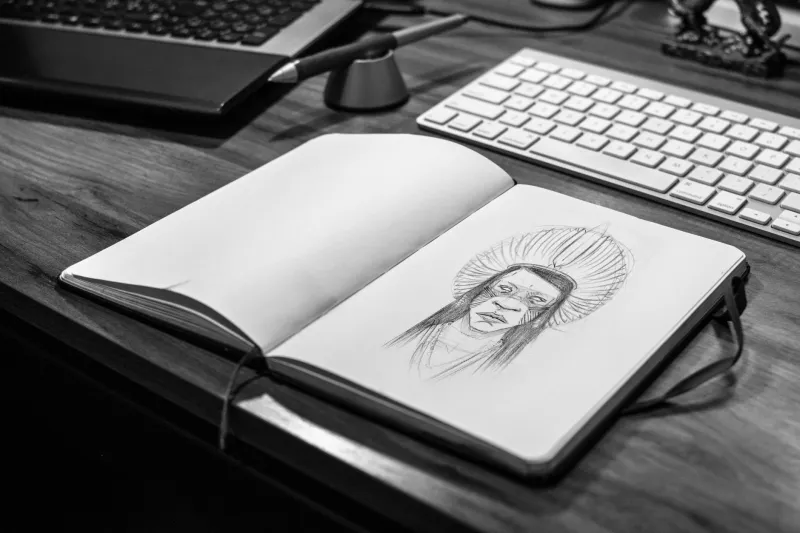
Picasso's notebooks are in museums. Da Vinci's journals — full of weird tangents, mechanical diagrams, anatomical sketches, and ideas that went absolutely nowhere — are considered among the most important artifacts in art history. Nobody looks at those pages and thinks well, he never finished this, so it doesn't really count.
And yet most creators treat their own process like something to be cleared away before company arrives.
We show the finished piece. We hide the sketchbook. We share the polished post and delete the fourteen drafts that preceded it. We perform completion and competence, and we bury the actual texture of how things get made.
That's worth questioning.
What Gets Lost in the Final Cut
Here's something that happens in almost every creative process: you make a decision that simplifies the work, and in doing so, you erase the evidence of every other direction you considered. The final version is cleaner, tighter, more resolved — and also, in some ways, less interesting than the chaos that produced it.
The abandoned subplot in a novel might be more alive than the chapter that replaced it. The first rough sketch of a character might capture something that the polished illustration smoothed out. The early demo of a song, recorded on a phone at 2 a.m., might have an energy the studio version spent thousands of dollars trying to recapture.
None of this means the final version is wrong. It means the process contains multitudes that the product can't fully hold.
Legacy, if you care about that kind of thing, isn't just about the finished work. It's about the full picture of how someone thinks, makes decisions, hits walls, recovers, and keeps going. That's the stuff that actually teaches other people. That's the stuff that makes a body of work feel human.
The Audience Is Changing What They Want
There's also a practical argument here, not just a philosophical one.
The way audiences engage with creators has shifted pretty dramatically in the last decade or so. The parasocial relationship between maker and audience has gotten more intimate, more process-oriented, more interested in the behind-the-scenes than ever before. People want access. They want to see the workspace, the revision history, the moment something clicked or didn't.
This isn't just a social media phenomenon, though social media has accelerated it. It reflects something real about how people learn from creative work. Watching someone navigate a problem in real time is more instructive — and often more compelling — than seeing the resolved solution. The struggle is the lesson.
Creators who understand this are building something more durable than a portfolio of finished work. They're building a living archive of how they think.
Dead Ends Are Data
Let's talk about the stuff that didn't work. The projects you abandoned. The experiments that failed. The stylistic phases you cringe at now.
Most creators want to pretend those don't exist. Understandable — nobody loves having their misfires on display. But those misfires are often the most instructive parts of a creative biography, both for the creator and for anyone who comes after.
When you document a dead end — even just a brief note about why you stopped, what you were trying to do, where it broke down — you're doing a few things at once. You're processing the failure in a way that makes it useful rather than just painful. You're creating a record that might be valuable to someone else working through similar territory. And you're being honest about the fact that the path to good work is never a straight line.
The creative mythology we've inherited tends to flatten process into genius. The thing arrived, fully formed, because the artist had some special access to inspiration. That story is almost never true, and it does real damage — it makes other creators feel like their stumbling, iterative, messy process is evidence of inadequacy rather than just evidence of how making things actually works.
Showing your dead ends is a corrective to that mythology. It's a gift to the people coming up behind you.
How to Document Without It Becoming a Second Job
Okay, so practically — what does this look like without turning process documentation into its own overwhelming creative project?
Keep it low-stakes. You don't need polished process content. A photo of your workspace mid-project, a quick voice memo about why you're stuck, a screenshot of a draft with notes on it — these are enough. The roughness is part of the point.
Date everything. Time is context. Knowing that a sketch came before a breakthrough, or that a rough draft sat untouched for six months before you figured out what it needed, adds layers of meaning that the artifact alone can't convey.
Save more than you think you need to. Storage is cheap. The instinct to clean up and delete is understandable, but you can't go back and reconstruct process after the fact. Archive generously and curate later.
Share selectively, but share. You don't have to publish everything. But make a habit of occasionally pulling back the curtain — a draft comparison, a note about what you tried and abandoned, a look at the version that almost was. Your audience will respond to it more than you expect.
The Museum That's Already Being Built
Whether you're intentional about it or not, you're already building a body of work. Every project, every draft, every pivot and restart is part of it. The question is whether you're treating that archive as something to manage and hide, or something to engage with and share.
The artists whose legacies feel most complete — most human, most instructive, most worth returning to — are usually the ones whose process is part of the record. Not because the process is always pretty, but because it's honest. Because it shows the work as something that was made by a person navigating real constraints and real uncertainty, not conjured whole from some mysterious creative ether.
Your sketchbook is not the rough draft of your legacy. It might be the most important part of it.