Where Two Roads Meet: The Creative Power of Blending What You Know
The Myth of the Pure Discipline
Somewhere along the way, we got sold on the idea that mastery means staying in your lane. Pick a thing. Get really good at that thing. Build a career around that thing. It sounds logical, maybe even noble. But spend five minutes looking at the work that actually stops people mid-scroll, mid-page, mid-gallery walk—and you'll notice something. The stuff that lands hardest almost always comes from someone who smuggled something unexpected into the room.
That's not an accident. It's a method.
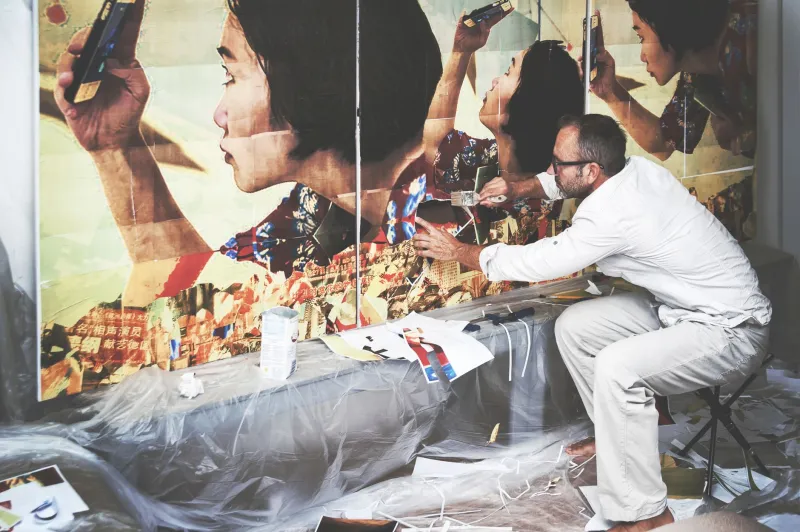
Let's call it the collage approach—not because it's messy or accidental, but because, like a great physical collage, it's about deliberately pulling from different sources and finding the tension between them. That tension? That's where the interesting stuff lives.
Real Creators, Real Crossovers
Consider what happened when graphic novelist Chip Kidd started applying his book cover design sensibility to his writing. His prose has this visual economy to it—images land like layouts, scenes are composed like spreads. You can feel the designer in the room when you read him. He didn't abandon one skill for another. He let them argue.
Or look at how chef and author Samin Nosrat built Salt Fat Acid Heat. She didn't write a cookbook. She wrote a theory of cooking—equal parts science education, memoir, and illustrated guide. Her background wasn't in publishing or science communication. She pulled from everywhere she'd lived and learned, and the result was something no single-discipline creator could have made.
Even in music, the most durable artists are usually the ones doing something genre-defiant. Bon Iver's Justin Vernon dragged indie folk through electronic production and classical arrangement. The result confused purists and created devotees. That's usually a good sign.
These aren't flukes. They're examples of what happens when someone stops treating their varied background as a liability and starts treating it as the whole point.
Why the Intersection Is the Idea
Here's the thing about working in the space between disciplines: nobody else lives there yet. If you're a photographer who spent years as an ER nurse, your eye for composition is going to be filtered through something most photographers don't have—an intimate familiarity with the body under pressure, with urgency, with the ethics of witnessing. That's not just a fun backstory. That's a lens.
The places where two bodies of knowledge meet are almost always underexplored. Most people are too trained in one field to venture into another, or too intimidated by their outsider status to commit. That gap is your opportunity.
The writer Austin Kleon has talked about this in terms of "being interesting at the edges." The center of any discipline is crowded. The edges—where your field meets something else—tend to be wide open.
Finding Your Own Creative Intersection
Okay, so how do you actually do this? A few frameworks worth trying:
Map your actual history. Sit down and list every skill, hobby, job, obsession, or passing fascination you've had—not just the ones that feel relevant. The summer you spent learning to weld. Your embarrassing deep knowledge of 1970s horror film scores. The two years you worked at a plant nursery. All of it. Now look for unexpected pairs. What happens when that thing meets your current creative practice?
Ask what your field is missing. Every discipline has blind spots. Visual art often lacks narrative rigor. Fiction sometimes lacks visual imagination. Journalism can lack emotional texture. What could you bring in from somewhere else that fills that gap?
Try a forced collision. Pick two things from your map that seem completely unrelated and spend a week making work at their intersection. Don't evaluate it yet. Just make it. You're looking for friction—and friction is generative.
Pay attention to what confuses people. When someone says "I'm not sure what to call what you do," that's often a sign you're onto something. Confusion from an audience can mean you're ahead of the category, not behind it.
The Risk Worth Taking
Blending disciplines isn't risk-free. You might alienate the audience you already have. You might feel like a fraud in both worlds for a while. There's a real discomfort in being the person who doesn't quite fit the existing shelves.
But the alternative is spending your creative life making work that already exists in a form someone else perfected. And honestly? That sounds worse.
The most durable creative voices aren't the ones who did one thing perfectly. They're the ones who found a combination nobody had tried and committed to it hard enough that the combination became a category of its own.
Your weird mix of backgrounds and fixations isn't something to apologize for. It might be the most interesting thing about what you make.
Start there.