Half-Built and Honest: What Your Unfinished Work Is Actually Saying
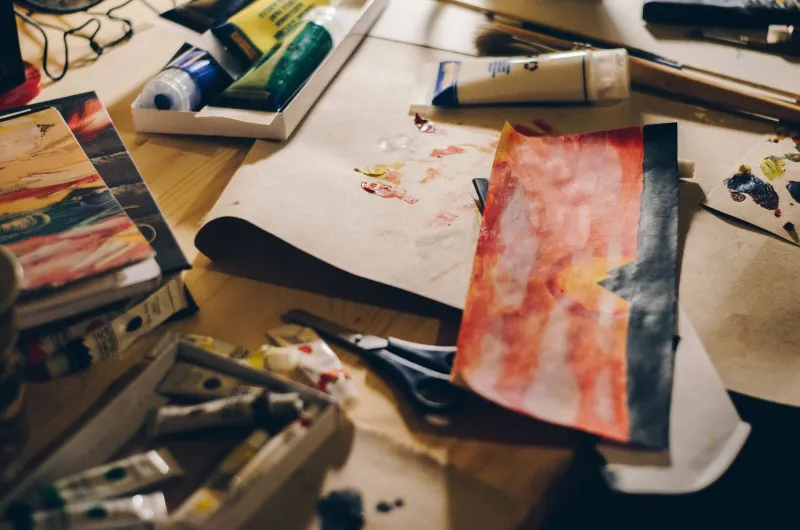
Somewhere on your hard drive — or in a sketchbook shoved under your desk, or in a voice memo you recorded at 11pm and never transcribed — there's a piece of work you haven't shown anyone. Not because it's bad. Because it's not done.
We've all got a graveyard of those. Half-written scripts. Paintings that stalled out at the underpainting stage. Songs that got as far as a verse and a vibe and then just... stopped. We carry them around like unfinished business, waiting for the day we'll finally have the time, the clarity, or the courage to wrap them up properly.
But what if the waiting is the wrong move? What if those half-built things are already saying something — something real, something specific, something that the finished version would actually dilute?
The Pressure to Present a Complete Self
There's a certain kind of pressure that comes with putting work out into the world, especially now. Portfolios are expected to be curated. Feeds are expected to be cohesive. Even personal projects get filtered through the question of how will this land? before they ever see the light of day.
The result is that most of what we share has been processed. Refined. Made safe for public consumption. And there's nothing inherently wrong with that — craft matters, and presentation matters. But somewhere in all that refinement, a lot of the most interesting material gets left on the cutting room floor.
What we're really afraid of, I think, is being caught mid-thought. Seen in the middle of figuring something out. There's a vulnerability in showing work that hasn't resolved itself yet, because it means admitting that you don't have all the answers. That you're still working through something.
Here's the thing though: that's exactly what makes it interesting.
Incompleteness as Authenticity
Think about the creative work that's stuck with you the longest. Not necessarily the most polished thing you've ever encountered — the thing that actually got under your skin. Chances are, part of what made it hit was a sense that the person who made it was genuinely wrestling with something. That there was still some heat in it, some unresolved tension that hadn't been ironed flat.
Audiences are remarkably good at sensing when something has been over-processed. When every rough edge has been smoothed away, when every question has been answered, when the work has been made so complete that there's no room left for the viewer to enter. Paradoxically, the more airtight a piece becomes, the harder it can be to actually connect with.
Raw work invites participation. It leaves space. It says I was here, thinking this, feeling this, and I haven't figured it out yet — and that honesty creates a kind of intimacy that finished work sometimes can't replicate.
What Artists Have Always Known (And Kept Quiet)
This isn't a new idea. Artists and writers have been wrestling with the myth of the complete work for as long as there's been art and writing. Franz Kafka asked his friend Max Brod to burn everything he left unfinished. Brod didn't. And now The Trial and The Castle — both incomplete — are considered some of the most important literary works of the 20th century.
Michelangelo left a series of sculptures in a state he called non-finito — literally, unfinished. Figures that appear to be emerging from the stone, half-formed, straining toward completion. Those pieces are considered masterworks. Not in spite of their incompleteness. Because of it.
The unfinished thing often carries the energy of becoming. And becoming is compelling in a way that arrived-and-settled rarely is.
The Psychological Weight of Waiting to Be Done
There's also a practical cost to treating your work-in-progress as something to be hidden until it reaches some mythical final form. That cost is time, momentum, and often the work itself.
Perfectionism is a well-documented creativity killer. When we hold work back indefinitely — waiting until it's ready, until we're ready — we often end up in a slow drift away from the project entirely. The gap between where the work is and where we think it needs to be becomes demoralizing rather than motivating. And then the thing just... dies. Not because it was bad, but because we couldn't tolerate its imperfection long enough to let it breathe.
Sharing work at earlier stages — even just with a small audience, even just occasionally — can actually be what keeps a project alive. Feedback changes the relationship. Conversation gives the work somewhere to go. And sometimes, seeing someone else respond to something you thought was half-baked makes you realize it was already whole in ways you hadn't recognized.
Reframing What 'Done' Even Means
Maybe the bigger shift here is conceptual. We tend to think of finished work as the goal and everything before it as prep — necessary but not the point. But what if the process itself is the point? What if the in-between states of a creative project are as worthy of attention as the final product?
Some creators are building entire practices around this idea. Process videos, studio diaries, serialized works-in-progress — these aren't just marketing tactics. They're a genuine expansion of what gets to count as creative output. The sketch matters. The draft matters. The version you made at 2am before you knew what you were doing matters.
Sharing those things doesn't undermine your work. It contextualizes it. It shows the thinking behind the making, which is often the most fascinating part of any creative story.
Give Yourself Permission to Show the Seams
I'm not saying abandon craft. I'm not saying skip the revision process or post every half-formed idea the moment it occurs to you. Finishing things still matters. Rigor still matters.
But there's a version of creative practice that's more honest, more sustainable, and more genuinely interesting — one where the in-between states are treated as legitimate rather than embarrassing. Where showing your seams isn't a vulnerability to be managed but a choice that deepens the work.
Your unfinished stuff isn't a liability. It's evidence of a mind actually at work. And in a creative landscape full of over-polished, carefully curated output, that kind of honesty is rarer than it sounds.
The half-built thing on your desk might be the most truthful creative statement you've made in years. Maybe it's worth letting someone else see it.